
 EN
EN


Repaired engine can only support "new machine 1/3"? —— 30An elderly technician has a thousand words long article that teaches you to make a major repair life 80%!6 major processes and 4 tips to save hundreds of thousands of dollars
Repaired engine can only support "new machine 1/3"? —— 30An elderly technician has a thousand words long article that teaches you to make a major repair life 80%!6 major processes and 4 tips to save hundreds of thousands of dollars
My colleagues often ask:
"Does a repaired engine last only a third of a new one?"
In fact - under the precondition of regular maintenance companies, the engine can fully reach the life of the new machine after major repairs.
What really reduces the life is the unregulated operation, the poor environment, the wrong parts, and the lack of detection and friction.
Based on my decades of field experience, I summarize the key elements below for peer reference and to give a "preventative shot" to some companies that want to save costs but want long engine life.
I. Prerequisites for a major repair
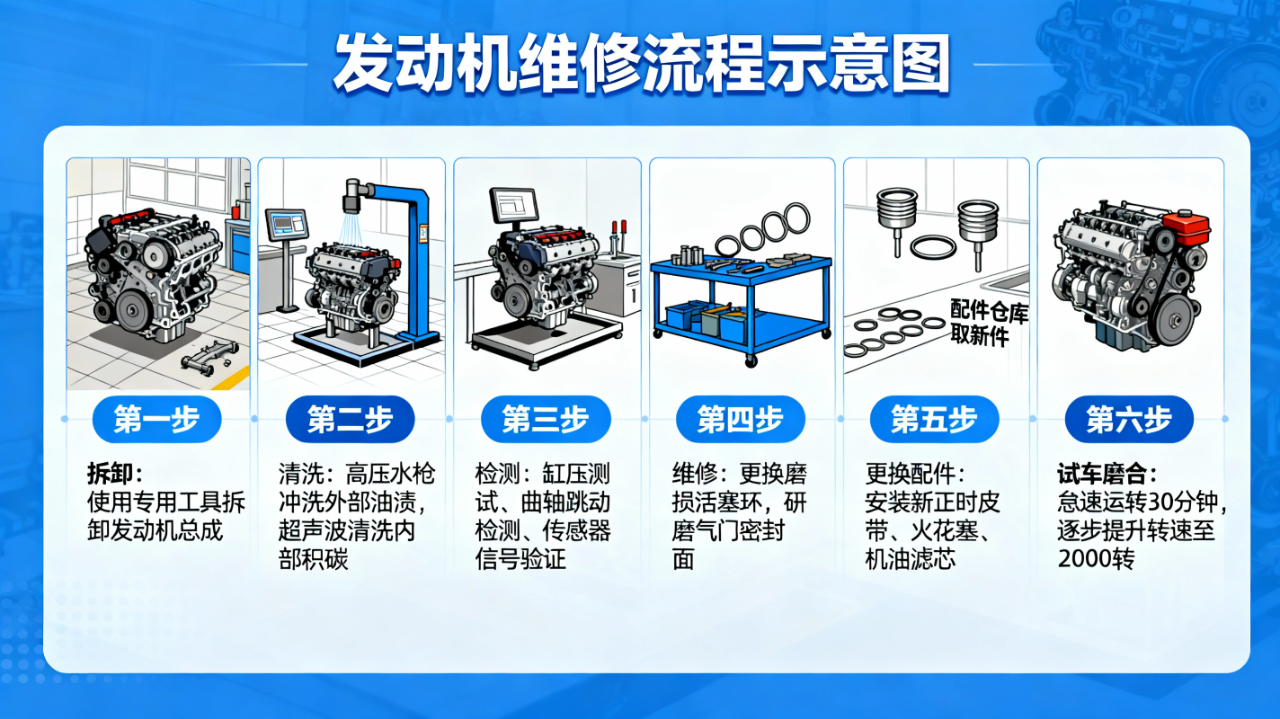
A major engine repair is not "tore, replace, and install" and must be carried out in a professional workshop with the following conditions:
-
A clean assembly environment -
Complete cleaning equipment -
Test bench, grinding bench -
Precision measurement tools (internal diameter meters, percent meters, thousandths of a degree, etc.) -
Experienced Maintenance Moderator
Without these basic conditions, life expectancy is empty.
More importantly, the quality of auxiliary parts cannot be controlled, and critical parts must not be used!
II. Core points of maintenance quality
1. Wash must be thorough (absolutely not avoided)
The following areas must be cleaned:
-
Airway, oilway -
Crankshafts, joints, interior of the body -
All pipelines -
The lubrication system
Also assess the extent of wear, decide on a replacement plan and register it.
Critical reminders:
-
Cap bolts, rod bolts, and shaft bolts are "plastic deformation bolts" and have a limit on the number of times they can be used and must be replaced if they cannot be confirmed. -
All bolts with torque requirements must be executed at the specified value and must not be "feeling"!
I once dealt with an accident in which the bolts of the crankshaft weighting block broke due to excessive torque, which directly damaged the body - typical "non-conformity."
2. The cleanliness of the assembly environment determines lifespan
Here's the real lesson:
-
A state-owned plant had a lot of wind and sand on site in winter, and the assembly environment was harsh, and an engine was scrapped after only a few hours of wear and tear - the reason was dust! -
My team hasn't had a similar early failure in decades, because of the commitment to cleanliness, despite the tough environment.
Practical methods:
-
Use compressed air to clean (available everywhere). -
When the temperature is suitable, clean the ground regularly with water. -
In winter, build a simple insulation shed to keep the humidity from dust. -
Four auxiliaries, oil lines and other precision components need to take time to assemble in a clean environment.
This is a low-cost but highly effective "indigenous approach."
3. Precision measurement and control of matching gaps
The following key components must be rigorously measured:
-
Curve axis curvature, radial / axial bending -
Difference in joint assembly weight -
Crankshaft + flying wheel balance -
Clearance between main bearing shell and connecting rod shell -
End gap and side gap of the piston ring -
Oil pump assembly (Try to replace it)
The key points of the lubrication system:
-
Check the oil filter side valve opening pressure -
Make sure the piston cools the nozzles properly. -
All oil channels must be thoroughly cleaned and lubricated in advance
Special reminders:
-
Never engage in so-called "reform" at all.
The cylinder liner is made of " laser quenching " to improve hardness , and the piston ring is worn out in a short period of time - a typical friction pair does not match .
4. Older engines should pay special attention to "hidden gaps."
Common problems with older machines:
-
Large gap between the shaft of the rocker and the rocker pore → substandard oil pressure -
Corrosion of the jet casing → Early failure -
Water pipes and oil pipes are ageing → Suggest that they be replaced as much as possible -
An abnormal oil pressure → You must find out the cause before you continue to operate
Remember: A major repair is "repair as much as possible," and a reproduction is "change without meeting the standard."
General enterprises have limited testing conditions, and it is more important to be cautious not to leave a hazard.
One important lesson:
All dismantled parts must be marked, used parts should be returned to their original position, non-used parts should be completely scrapped, and must not be mixed.
5. Grease and early inspection after a major repair
The 50 hours after repair is a "hazardous period" and must be monitored with priority:
-
water temperature -
Oil pressure -
A loud noise -
Oil leaking, oil leaking -
Smoking Situation
Any exceptions must be reported and processed immediately.
6. It must be maintained twice 50 hours after repair.
It includes:
-
Replace the oil -
Replace the filter -
Check for looseness -
Review water temperature and oil pressure
This step is avoided by many companies, often resulting in engine problems lasting 200 hours.
III. Some practical tips (high value)
-
Gas admittance system can wipe out ash → four necessary life is not long. -
There is oxidized residue under the valve chamber lid → The oil is of substandard quality and the engine is going to be scrapped. -
Water temperature management is key: the engine now has a small water capacity, and when there is a shortage of water, it gets hurt. -
Checking the oil and water levels of cold engines is a daily routine for operators. -
Be sure to participate in professional training when necessary, otherwise it is easy to lose out on experience.
summary
The life of an engine overhaul is not a technical problem, but:
-
Are they performed in accordance with the norms? -
Is there a detection capability? -
Would you be willing to replace critical parts? -
Whether cleaning and measurement are guaranteed to be accurate -
Whether the wear and maintenance is completed -
Whether qualified oils and maintenance items are used
As long as these are done , the overhaul to reach the original machine 80 % of the life is not difficult .

 ONLINE